

About Add Health
Initiated in 1994, The National Longitudinal Study of Adolescent to Adult Health (Add Health) is the largest, most comprehensive nationally-representative longitudinal study of adolescents ever undertaken. Wave I included over 20,000 U.S. adolescents in grades 7-12 in the 1994-95 school year. Most recently, study participants were age 44, on average, during the Wave VI data collection effort. Wave VI of Add Health was primarily funded by the National Institute on Aging; earlier waves of Add Health were primarily funded by program project grants from the Eunice Kennedy Shriver National Institute of Child Health and Human Development, with co-funding from 23 other federal agencies and foundations.
Over the years, Add Health has collected rich demographic, social, familial, behavioral, psychosocial, cognitive, and health survey data from participants and their parents; a vast array of contextual data from participants’ schools, neighborhoods, and geographies of residence; and in-home physical and biological data from participants, including genetic markers, blood-based assays, anthropometric measures, and medications. Ancillary studies have added even more data over the years. Data from the project are available in various forms and have been analyzed in thousands of publications in peer-reviewed journals.
In addition to six waves of Add Health survey and biological data, Add Health investigators have also collected data on the parents of Add Health participants and a vast amount of ‘Omics data. Many existing databases with information about respondents’ neighborhoods and communities have also been linked to Add Health data and are available for use. Both birth records data and mortality records data are also available for subsets of Add Health participants.
Add Health Study Design
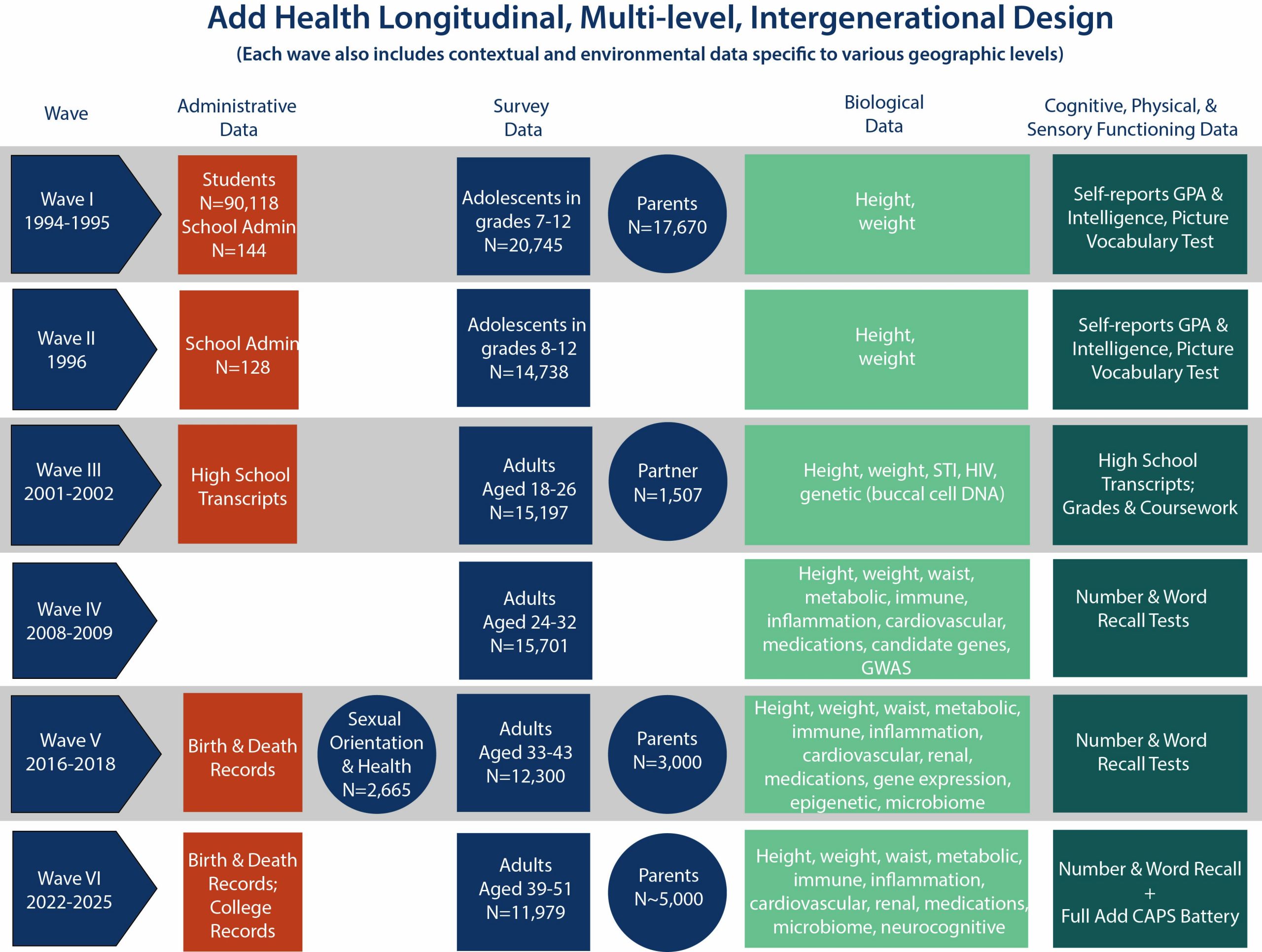
Core Add Health Data
Funders
Wave VI
National Institute on Aging (NIA)
Eunice Kennedy Shriver National Institute of Child Health & Human Development (NICHD)
National Institute of Drug Abuse (NIDA)
National Institute on Minority Health and Health Disparities (NIMHD)
Office of the Director, National Institutes of Health (OD/NIH)
Wave V
Eunice Kennedy Shriver National Institute of Child Health and Human Development (NICHD)
National Institute on Deafness and Other Communication Disorders (NIDCD)
National Institute on Drug Abuse (NIDA)
National Science Foundation (NSF)
Office of the Director, National Institutes of Health (OD/NIH)
Wave IV
Eunice Kennedy Shriver National Institute Of Child Health & Human Development (NICHD)
National Institute Of Nursing Research (NINR)
National Center On Minority Health And Health Disparities (NCMHD)
National Institute On Deafness And Other Communication Disorders (NIDCD)
National Institute On Alcohol Abuse And Alcoholism (NIAAA)
Office of the Director, National Institutes of Health (OD/NIH)
National Institute On Aging (NIA)
National Institute On Drug Abuse (NIDA)
National Cancer Institute (NCI)
National Institute of Allergy and Infectious Diseases (NIAID)
Office of Behavioral and Social Sciences Research, NIH (OBSSR)
Office of Research on Women’s Health, NIH (ORWH)
Office of the Assistant Secretary for Planning and Evaluation, DHHS (ASPE)
Office of Population Affairs, DHHS (OPA)
National Center for Injury Prevention and Control, Centers for Disease Control and
Prevention, DHHS (CDC)
Office of AIDS Research, NIH (OAR)
MacArthur Foundation
Add Health Co-funders 1994 to 2005
Eunice Kennedy Shriver National Institute Of Child Health & Human Development (NICHD)
National Institute On Drug Abuse (NIDA)
Office of the Director, National Institutes of Health (OD/NIH)
National Institute Of Nursing Research (NINR)
National Institute On Alcohol Abuse And Alcoholism (NIAAA)
National Institute On Deafness And Other Communication Disorders (NIDCD)
National Cancer Institute (NCI)
National Center for Health Statistics, Centers for Disease Control and Prevention, DHHS (NCHS)
National Institute of General Medical Sciences (NIGMS) National Institute of Mental Health (NIMH)
Office of Minority Health and Health Disparities, Centers for Disease Control and Prevention, DHHS (OMHHD)
Office of Minority Health, Office of Public Health and Science, DHHS (OMH)
National Institute of Allergy and Infectious Diseases (NIAID)
National Institute of Diabetes and Digestive and Kidney Disease (NIDDK)
Office of AIDS Research, NIH (OAR)
Office of Behavioral and Social Sciences Research, NIH (OBSSR)
Office of Research on Women’s Health, NIH (ORWH)
Office of Population Affairs, DHHS (OPA)
Office of the Assistant Secretary for Planning and Evaluation, DHHS (ASPE)
National Center for Injury Prevention and Control, Centers for Disease Control and Prevention, DHHS (CDC)
National Science Foundation
Robert Wood Johnson Foundation