Data
The Add Health study has collected data of interest to investigators from many disciplines in the social and behavioral sciences and from many theoretical traditions, making it a global data resource for over 50,000 researchers. The Add Health data are available in two forms, public-use data and restricted-use data, and offer endless options in the types of analysis, choices of data, and presentation.
Public-Use Data Sets
The public-use data sets contain all the survey data but only for a subset of the full Add Health sample.
- Wave I (N=6,504)
- Wave II (N=4,834)
- Wave III (N=4,882)
- Wave IV (N=5,114)
- Wave V (N=4,196)
- Wave VI (N=3,937)
Restricted-Use Data Sets
The extensive restricted-use data, available by contractual agreement, contains data for all study participants and will be distributed only to certified researchers who commit themselves to maintaining limited access. All applications for new contracts or renewals can be accomplished online in the Add Health Contracts Management System (CMS). Access to the CMS is via the Data Portal. There are two types of restricted-use contract options – Secure Research Workspace (SRW) or Home Institution – dependent on your current or intended method of accessing Add Health restricted-use data. Visit the Restricted-Use Contract Options page for additional information.
Reminder: Access to Wave VI data files is only allowed through the UNC Secure Research Workspace (SRW) and a Home Institution contract.
Adding Data to Add Health
Collaborators have added rich datasets to Add Health that have been used by thousands of researchers and greatly contributed to scientific knowledge. Add Health has established a set of requirements for investigators seeking to add supplemental, contextual or biological data to Add Health, under the auspices of an Add Health Ancillary Study. Visit the Adding Data page to learn about procedures and guidelines for adding contextual or biological data to the Add Health data sets, including data linkages. A full list of completed and approved ancillary studies is available for reference.
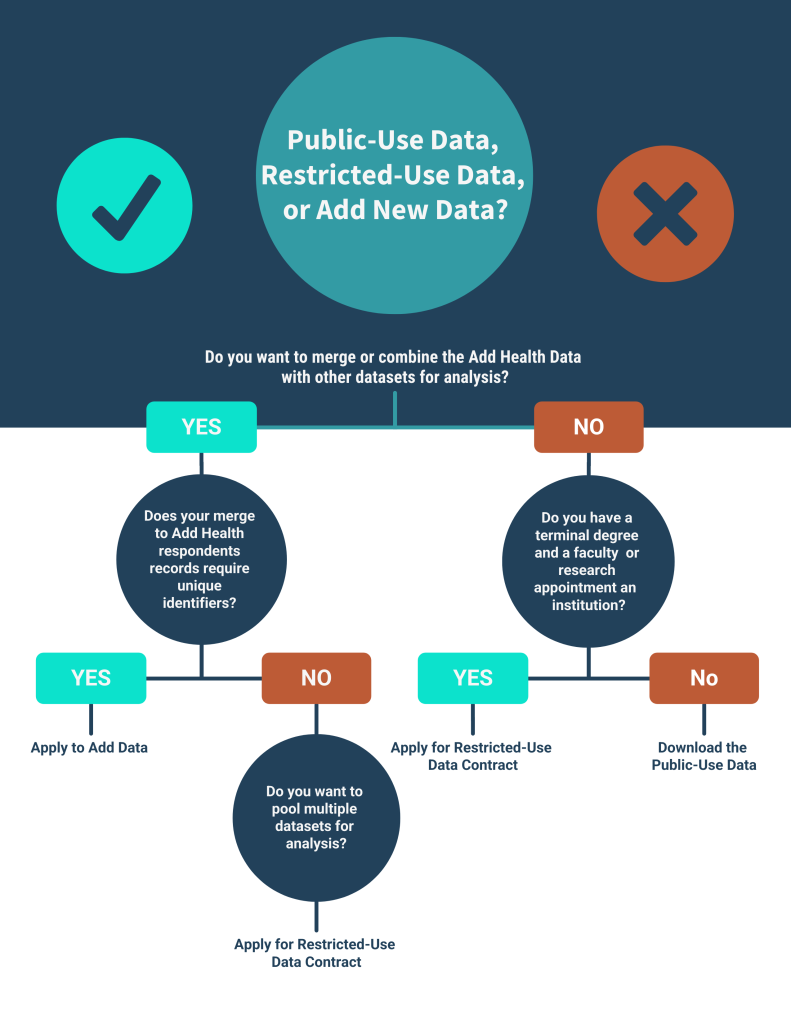
To help determine which data may suit your needs best, please refer to the Data Decision chart below.